
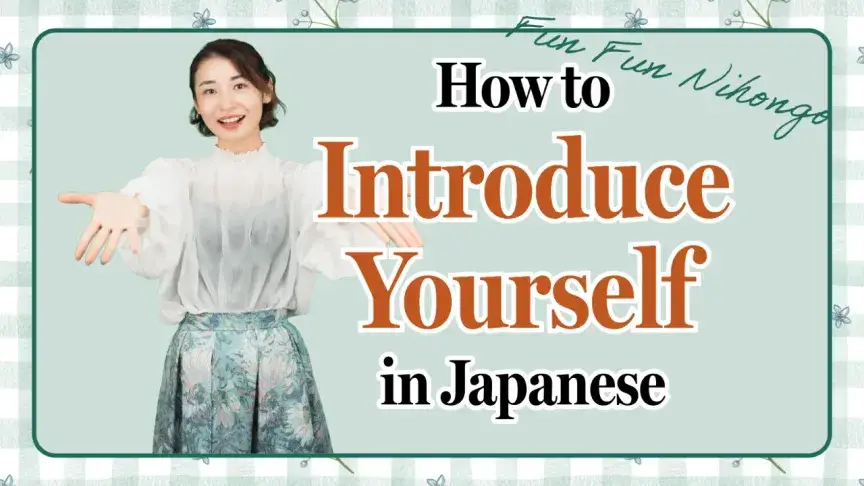
Introducing yourself is one of the first things you need to do when speaking Japanese. In this article, we’ll go through common self-introduction expressions step by step and explain how to use them naturally in real situations.
目次
This article is based on a video by Fun Fun Nihongo, our Japanese learning content series.
Common Japanese Self-Introduction Phrases
Below are common expressions used when introducing yourself in Japanese.
For each one, you’ll see how the phrase is used, followed by real example lines from our Fun Fun Nihongo videos.
はじめまして。
- Hajimemashite.
Nice to meet you.
This phrase is used at the very beginning of a self-introduction. It’s polite, standard and works in almost any situation — from casual meetings to formal introductions. It’s usually followed by your name or a short self-introduction.
私は~です。
- Watashi wa ~ desu.
My name is ~.
This is the most common way to say your name in Japanese. It’s neutral and polite, making it suitable for both formal and casual introductions. In natural conversation, 私は is often omitted when it’s clear who you’re talking about.
Example
- 私はラッファエーレです。
Watashi wa Raffaele desu.
I am Raffaele.
~と呼んでください。
- ~ to yonde kudasai.
(Please) call me ~.
If you have a nickname or preferred name, you can add this line after introducing yourself. It’s often used in friendly or international settings.
Example
- ラッファと呼んでください。
Raffa to yonde kudasai.
Please call me Raffa.
~出身です。
- ~ shusshin desu.
I’m from ~.
This expression is used to talk about where you’re from. You can use it for a prefecture, city or country.
Example
- イタリアのシチリア出身です。
Itaria no sichiria shusshin desu.
I'm from Sicily, Italy.
~が話せます。
- ~ ga hanasemasu.
I can speak ~.
Use this sentence to say which languages you can speak. When listing multiple languages, connect them with と.
Example
- 英語とタガログ語が話せます。
Eigo to Tagarigugo ga hanasemasu.
I can speak English and Tagalog.
~をしています/~について勉強しています。
- ~ o shiteimasu / ~ ni tsuite benkyō shiteimasu.
I work as ~ / I’m studying ~.
These expressions are used to talk about your job or what you’re currently studying. When listing multiple activities or fields, you can connect them with と.
Examples
役者をしています。
Yakusha o shiteimasu.
I work as an actor.歌とお芝居について勉強しています。
Uta to oshibai ni tsuite benkyō shiteimasu.
I am studying singing and acting.
趣味は~です。
- Shumi wa ~ desu.
My hobby is ~.
This is a natural and simple way to talk about your hobbies. This is very common in self-introductions and easy for beginners to use.
Example
- 趣味は登山と映画鑑賞です。
Shumi wa tozan to eiga kanshō desu.
My hobbies are mountain climbing and watching movies.
好きな食べ物は~です。
- Suki na tabemono wa ~ desu.
My favorite food is ~.
This phrase is often used in casual self-introductions to add a personal touch and start conversations.
Example
- 好きな食べ物は寿司です。
Suki na tabemono wa sushi desu.
My favorite food is sushi.
~が得意です。
- ~ ga tokui desu.
I’m good at ~.
Use this expression to talk about skills or things you’re confident in.
Example
- ダンスが得意です。
Dansu ga tokui desu.
I am good at dancing.
~によく行きます/~が好きです。
- ~ ni yoku ikimasu / ~ ga suki desu.
I often ~ / I like ~.
These expressions are useful for talking about your habits (~によく行きます) and general preferences (~が好きです) in daily life.
Examples
美術館によく行きます。
Bijutsukan ni yoku ikimasu.
I often go to art museums.温泉が好きです。
Onsen ga suki desu.
I like going to hot springs.
Recently, I’ve gotten into ~.
最近、~にハマっています。
- Saikin, ~ ni hamatteimasu.
Recently, I’ve gotten into ~.
This phrase is used to talk about new or recent interests, often ones you feel strongly about.
Example
- 最近、ワインにハマってます。
Saikin, wain ni hamattemasu.
I have recently gotten into wine.
将来の夢は~です。
- Shōrai no yume wa ~ desu.
My dream is ~.
This sentence is often used toward the end of a self-introduction to talk about future goals.
Example
- 将来の夢は世界一周旅行をすることです。
Shōrai no yume wa sekai isshū ryokō o surukoto desu.
My dream is to travel around the world.
よろしくお願いします。
- Yoroshiku onegaishimasu.
I look forward to getting to know you.
This phrase is widely used as a general greeting in Japanese, and it’s also commonly said at the end of a self-introduction. It helps you sound polite, friendly and natural. It doesn’t have a direct English equivalent, but it signals goodwill and openness toward the other person.
Quick Tip
You don’t need to use every expression when introducing yourself. In most situations, just your name, where you’re from and one or two extra details are more than enough.
Follow Us on Social Media
Want more fun Japanese learning content? We post weekly videos, quizzes and cultural tips across multiple platforms!
Fun Fun Nihongo
Instagram
Threads
Facebook
TikTok
YouTube
X

Performers, Fun Fun Nihongo
Hinaka and Kotone feature in the Fun Fun Nihongo video series, where they share natural Japanese expressions and cultural insights with learners of Japanese.
Instagram: @hinaka_kudo / @kotonefromjapan


![『キクタンTOEIC L&Rテスト 1000』[音声DL付]](https://image-ej.alc.co.jp/images/UofmRBTIrITOX3g5v0MYrFs.webp)