
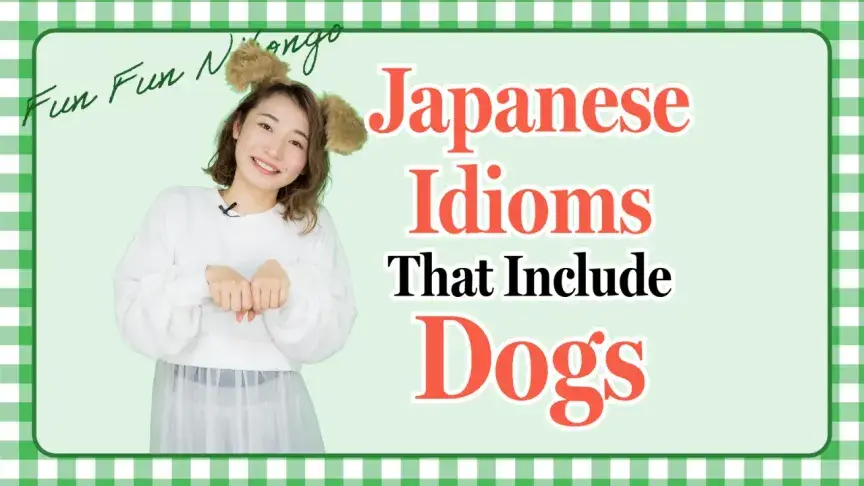
In Japanese, animals often appear in idioms and proverbs, and dogs are one of the most common. These expressions usually aren’t about real dogs, but about people, relationships and everyday situations. In this article, we introduce several Japanese idioms that include 犬 (inu), based on a Fun Fun Nihongo video, and look at what they really mean in use.
目次
This article is based on a video by Fun Fun Nihongo, our Japanese learning content series.
Japanese Idioms That Include Dogs
Below are some well-known Japanese idioms that include 犬 (inu).
For each idiom, you’ll see the original Japanese, a literal translation and then an explanation of what it actually means in everyday use.
犬も歩けば棒に当たる
inu mo arukeba bō ni ataru
Literal translation
If a dog walks, it will hit a stick.Meaning
When you take action, you gain experience — sometimes good luck, sometimes bad luck. The phrase suggests that doing nothing avoids trouble, but taking action can also lead to unexpected results.
犬猿の仲
ken’en no naka
Literal translation
A dog-and-monkey relationship.Meaning
A very bad relationship where people constantly fight and dislike each other. It’s used to describe two people who simply don’t get along. A similar idea in English is “fighting like cats and dogs.”
負け犬の遠吠え
make inu no tōboe
Literal translation
A defeated dog howls from afar.Meaning
A loser complains or criticizes from a safe distance after losing. It often refers to someone who talks big only after things are already over.
犬死に
inu jini
Literal translation
The death of a dog.Meaning
To lose one’s life for nothing, or to make a sacrifice that has no meaning or result. This expression has a strong and serious tone.
飼い犬に手を噛まれる
kai inu ni te o kamareru
Literal translation
A pet dog bites its owner’s hand.Meaning
Being betrayed by someone you have helped or trusted. It’s used when kindness is returned with harm.
夫婦喧嘩は犬も食わない
fūfu genka wa inu mo kuwanai
Literal translation
Even a dog won’t eat a married couple’s quarrel.Meaning
Marital quarrels are so trivial that no one wants to get involved. The phrase suggests such arguments should be ignored by others.
犬が西向きゃ尾は東
inu ga nishi mukya o wa higashi
- Literal translation
If a dog faces west, its tail faces east.
^ Meaning
Something extremely obvious and self-evident. It’s used when stating something that needs no explanation.
犬に論語
inu ni rongo
Literal translation
To recite Confucian teachings to a dog.Meaning
Giving wisdom to someone who cannot appreciate or understand it. Similar to “casting pearls before swine” in English.
犬は三日飼えば三年恩を忘れぬ
inu wa mikka kae ba sannen on o wasurenu
Literal translation
If you take care of a dog for three days, it will remember your kindness for three years.Meaning
Dogs are loyal and never forget kindness. By extension, the phrase reminds people not to forget the kindness they have received from others.
Quick Tip
Many idioms like these are more common in writing, manga or storytelling than in everyday conversation. You don’t need to use them yourself — understanding their meaning is often enough to enjoy Japanese media and follow conversations more easily.
Follow Us on Social Media
Want more fun Japanese learning content? We post weekly videos, quizzes and cultural tips across multiple platforms!
Fun Fun Nihongo
Instagram
Threads
Facebook
TikTok
YouTube
X

Performers, Fun Fun Nihongo
Hinaka and Kotone feature in the Fun Fun Nihongo video series, where they share natural Japanese expressions and cultural insights with learners of Japanese.
Instagram: @hinaka_kudo / @kotonefromjapan



![Realize 英文法MASTERY[基礎~必修レベル]](https://image-ej.alc.co.jp/images/bBT3gAn5OxGzsbPex.webp)